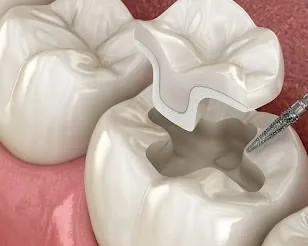
Inlays are custom fit fillings made in a laboratory. First, the decay is cleaned from your tooth and then an impression of the tooth is made and sent to the lab. In the interim a temporary filling is used to fill in the space and protect your tooth from fracture or further deterioration.
There are several types of materials to fabricate an inlay. Which are porcelain and composite inlays.
The first type of inlay is a porcelain inlay, which is colored to match your tooth. In addition to being aesthetically pleasing the other benefits of porcelain inlays are that they are also quite stain resistant and hard.
The second type of inlay is made of tooth colored composites. Like the porcelain inlays, composite inlays are also very aesthetically pleasing. Both types of inlays are bonded or glued to your teeth with special cements.
Transcript
inlays and onlays are fillings that can replac the conventional Restorations that are done in the clinic they are recommended in a case where the cavity or the filling already present covers too large an area with regard to the remaining natural surface a conventional filling does not solidify the tooth it only FS the cavity in which it is placed as time goes by it might expand increasing the risk Dental fracture or even contract increasing the possibility of Decay and reducing considerably the strength of the remaining natural structures the condensation present in a mouth when inserting The Filling material is one of the factors of contamination responsible for modification in the size the bigger the restoration the more the filling will be effective if by mishap the tooth is fractured below the gum the tooth must either be extracted or if the fracture is not too deep a step will be added to the treatment we shall then proceed to the lengthening of the clinical Crown this is why it's important that your dentist see to it to all your feelings be faultless before it is too late it would be crucial to think of a long-term solution for all all teeth presenting a faulty restoration your dentist can advise you of the most appropriate solution contrary to the Restorations done in the clinic the inlay or onlay is manufactured in a laboratory as a model for impressions of the trimmed tooth no contamination or condensation is possible therefore instead of weakening the natural wall remaining the inlay or onlay will contribute to its reinforcement two to three appointments will be necessary for the complete procedure first the dentist will grind down the tooth making sure no trace of Decay or former filling is left then he or she will take a very precise impression of the trimmed tooth and will send it to the lab where they will proceed to the making of the inlay or onlay it is possible to have a choice of the material used for the fabrication of the inlay or or onlay it may be porcelain resin or gold you may discuss your choice with your dentist before the impression is sent to the laboratory while the inlay or onlay is being prepared in the lab a temporary filling will be put in on the last visit the temporary filling will be replaced by the inlay or if the restoration includes a cusped by an onlay it will be cemented in place and an adjustment will be made if NE necessary this simple technique allows 90% of the original strength of your tooth to be recovered in addition it is aesthetic
Porcelain Inlay & Composite Inlay Post Treatment Expectation
Following the inlay treatment it is very common to experience some discomfort, normally at the site of the anesthetic or at the tooth itself. To alleviate the discomfort you can follow your dentist recommendation on taking an over the counter pain medication such as Advil. If your symptoms persist for more than few days, you should visit your dentist.
In some cases and due to variety of reasons your inlay could become loose. In this case you should contact or visit your dentist.
Please keep in mind the longevity of a filling depends in large part on your oral hygiene and diet. Be sure to maintain your filling with proper brushing and flossing.
If you have any additional questions, please consult with the dentist.