
At Dental Options we provide dental crowns and bridges solution to our patients in Aventura. We create customizes dental crowns and bridges for those patients with missing, fractured, damaged or decayed tooth. Dental crowns and bridges look and feel like natural tooth. These treatments are used for a long-lasting correction of major dental problems. No matter how complex your dental condition, we are here to improve your dental health and appearance of your mouth with a dental crown or bridge. Schedule an appointment with us or contact us to discuss your cosmetic goals and perform a comprehensive examination of your dental health to ensure that you receive exactly the care to restore your attractive and natural smile.
What are Dental Crowns?
Transcript
A dental crown is tooth-shaped cap that is permanently cemented over a tooth, in order to restore the tooths strength, shape and size, and improve its appearance. The crown will cover the visible portion of the tooth above and right at the gum line, once it is cemented into place.
Crowns are used to hold weak, broken or cracked teeth together to avoid further fracturing. Crowns are also used to support large fillings, attach a bridge, or cover discolored or deformed teeth. Crowns may also be placed over dental implants.
The dentist usually requires two dental visits to install a crown. First, the dentist needs to prepare the tooth or implant for the crown. The dentist will grind and shape the tooth so that the crown can be fitted over it. Then, the dentist makes an impression of tooth and surrounding gums, which is then sent to a dental laboratory so that the crown can be created. The dentist fits a temporary crown over the tooth, until the permanent crown is ready. During the second visit, dentist will remove the temporary crown and cement the finished permanent crown onto the tooth.
Crowns generally last about five to eight years, and with good oral hygiene most crowns last longer. Certain habits such as fingernail biting, chewing ice, and grinding teeth can do damage to the crown, and should be avoided.
What are Dental Bridges
Transcript
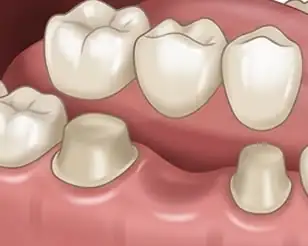
Dental bridges are used to replace one or more missing teeth in your mouth. Dental bridges are fixed, in that they are cemented on the supporting teeth, or in some cases fixed on the dental implant that has been placed next to the missing teeth.
Importance of Replacing the Missing Teeth
Replacing the missing teeth will restore your ability to properly chew and speak besides its cosmatic advantage; in addition the space caused by the missing teeth may allow the surrounding teeth to shift into that space. This shifting could cause a misalignment in your bite that can result in problems with your jaw joint. These shifted teeth are harder to clean, making them more susceptible to gum disease, decay or even additional tooth loss.
The Dental Bridge Treatment
It normally takes two or more visits for your dentist to complete your bridge. On your first visit the supporting teeth, which are typically the ones on either side of the missing tooth, are prepared. This is done to make room for the crowns that will slide over the supporting teeth. These crowns also serve as holders of the pontic, which is the missing tooth’s replacement.
Next, an impression of the supporting teeth is made so a dental laboratory can custom fit the bridge. Finally a temporary dental bridge is inserted to protect the supporting teeth as well as the space between them.
On your second visit the permanent bridge is placed and adjusted to insure proper fit and function. If the fit of the bridge is satisfactory your dentist will proceed with permanently cementing the bridge into place.
Dental Bridge Post Treatment Expectations
After the successful completion of the bridge you may feel some discomfort, mild pain when biting or sensitivity to temperature changes for a few days. As advised by your dentist, you can take over-the-counter pain medicine, such as Advil that contains ibuprofen, to alleviate the discomfort. If these symptoms persist more than a few days, visit your dentist.
Cleaning Your Dental Bridge
The longevity of your dental bridge depends in large part on the quality of the material in the bridge, as well as your oral hygiene, diet and the health of the supporting teeth and gums. Please ask your dentist for proper brushing and flossing techniques.